
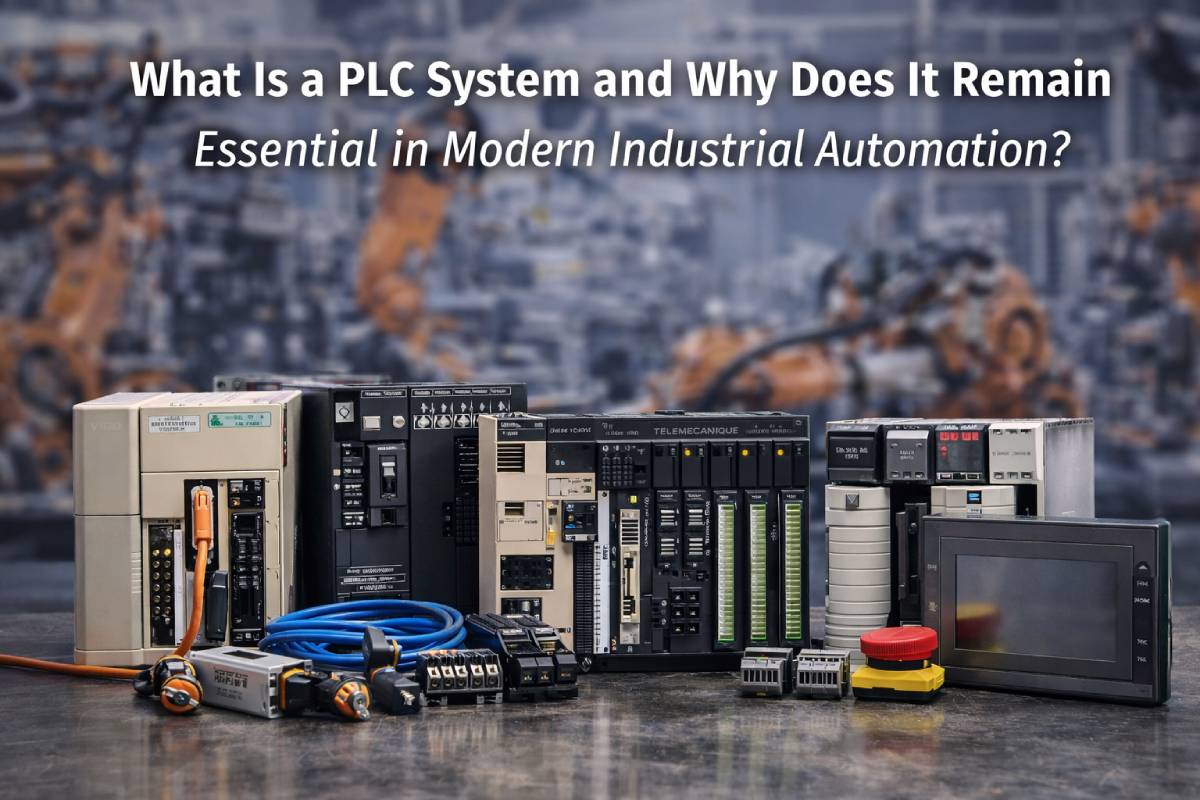
Why PLC Control Systems Still Power Modern Industrial Automation
Programmable Logic Controllers are the hidden engines behind modern manufacturing. From robotic assembly lines to automated packaging systems, PLC systems coordinate complex industrial processes with precision and reliability. This article explains what a PLC system is, how PLC control systems function, and why many facilities continue to rely on legacy PLC hardware. It also explores the practical reasons engineers often maintain existing PLC platforms rather than replacing them with newer automation technologies.
What Is a PLC System and Why Does It Remain Essential in Modern Industrial Automation?
When engineers ask what is a PLC system, they are often looking for more than a simple definition. In industrial environments, PLC systems form the backbone of automation architecture, controlling machinery, coordinating production lines, and ensuring processes operate safely and efficiently.
A PLC control system (Programmable Logic Controller) is a ruggedised industrial computer designed to monitor inputs, execute programmed logic, and control outputs in real time. These systems operate in demanding industrial environments where reliability, speed, and precision are essential.
Despite the rise of distributed control systems and industrial PCs, PLC systems remain fundamental to dependable automation. Their stability and deterministic performance make them the preferred control layer for countless manufacturing operations.
What Is a PLC Control System?
A PLC control system is composed of both hardware and software components specifically engineered for high-speed, deterministic control in industrial environments.
At its core, a PLC system includes several essential elements:
- Central Processing Unit (CPU)
- Input and Output (I/O) modules
- Power supply system
- Communication interfaces
- Programming software
The PLC continuously monitors incoming signals from field devices such as sensors, limit switches, encoders, and analogue transmitters. These signals act as inputs to the control program.
Based on programmed logic, the PLC then activates outputs that control motors, actuators, valves, relays, or other mechanical devices. Engineers typically program PLC systems using ladder logic, structured text, or function block diagrams.
Because of their reliability and flexibility, PLC systems are widely used in industries such as:
- Automotive manufacturing
- Food and beverage processing
- Material handling and logistics
- Packaging automation
- Robotics integration
- Energy generation facilities
Across these sectors, PLC control systems ensure production processes operate consistently and safely.
How Did PLC Systems Evolve?
The origins of PLC systems date back to the late 1960s. They were originally developed to replace complex relay-based control panels used in automotive manufacturing.
Traditional relay panels required extensive wiring and were difficult to modify. When production changes were needed, engineers often had to manually rewire entire control cabinets.
PLC technology solved this challenge by introducing programmable control. Instead of rewiring circuits, engineers could simply update the control program.
Over the following decades, PLC systems continued to evolve. Major improvements appeared throughout the 1980s and 1990s, including:
- Modular input/output expansion
- Industrial communication protocols
- Faster processing speeds
- Integrated motion control
- Advanced system diagnostics
Leading automation manufacturers such as Siemens, Allen-Bradley (Rockwell Automation), Mitsubishi Electric, and Omron played key roles in advancing PLC hardware and software capabilities.
Many production lines installed during these decades still operate using their original PLC platforms.
Why Do Legacy PLC Systems Remain in Operation?
In industrial automation, stability often takes priority over novelty. Many manufacturing facilities operate continuously for years using validated automation systems built around specific PLC platforms.
Replacing an existing PLC control system can involve significant engineering work, including:
- Rewriting ladder logic programs
- Reconfiguring input and output architecture
- Updating HMI interfaces
- Revalidating safety interlocks
- Scheduling production downtime for commissioning
Because of these complexities, many facilities prefer maintaining their existing PLC hardware rather than redesigning entire automation systems.
However, a common challenge arises when these legacy PLC models reach end-of-life status. Once manufacturers discontinue a product line, sourcing compatible replacement units becomes more difficult.
Specialist suppliers such as K2 Automation help address this challenge by sourcing discontinued PLC systems and modules that are no longer available directly from the manufacturer.
This allows engineers to maintain system continuity while avoiding costly system redesigns.
What Are the Core Components of a PLC System?
Understanding PLC architecture is essential for engineers responsible for system maintenance, upgrades, or troubleshooting.
Several core components work together to create a complete PLC control system.
CPU (Central Processing Unit)
The CPU is the brain of the PLC. It executes control logic, processes incoming signals, and determines the appropriate outputs. Processing speed and memory capacity influence overall system performance.
I/O Modules
Input modules receive signals from sensors and field devices. Output modules send commands to actuators, motors, and control elements. Modular design allows systems to expand as automation requirements grow.
Communication Interfaces
PLC systems communicate with other devices through industrial networks. These may include protocols such as:
- Profibus
- Modbus
- Ethernet/IP
- Proprietary manufacturer networks
Communication modules allow PLCs to interact with HMIs, SCADA systems, and other automation equipment.
Power Supply and Rack System
The rack structure houses the PLC modules and distributes electrical power across the system. Proper rack configuration ensures reliable communication between modules.
Each component must remain compatible with the overall automation architecture.
Engineering Risks of Replacing PLC Systems
Although upgrading automation platforms can offer new features, replacing an existing PLC control system may introduce significant engineering risks.
Some potential issues include:
- Incompatibility with existing field wiring
- Firmware or software conflicts
- Timing inconsistencies within control loops
- Safety validation requirements
- Integration challenges with SCADA or HMI systems
Because of these risks, many engineers choose to maintain their existing PLC hardware when possible.
PLC Systems in Robotics and Advanced Automation
In modern industrial environments, PLC systems often operate alongside motion controllers, servo drives, and robotic systems.
Within robotic cells and automated production lines, PLC control systems perform several critical functions:
- Managing machine sequencing logic
- Coordinating multi-axis motion operations
- Monitoring safety circuits and emergency stops
- Integrating machine vision systems
- Synchronising devices across industrial networks
Even as Industry 4.0 technologies evolve, PLC systems continue to serve as the deterministic control layer beneath more advanced automation platforms.
Their predictable performance and reliability make them indispensable in complex automation architectures.
Why Are Some PLC Systems No Longer Manufactured?
Like most industrial technologies, PLC platforms follow defined product life cycles. As new generations of hardware are introduced, manufacturers gradually phase out older models.
Newer PLC platforms may offer enhanced processing power, improved communication capabilities, and expanded software functionality.
However, these newer systems are not always fully backward compatible with legacy installations.
For facilities operating validated automation systems, upgrading to a new PLC platform can require major redesign work.
Specialist suppliers such as K2 Automation provide access to discontinued PLC systems that are no longer manufactured, helping facilities maintain operational stability without redesigning their automation architecture.
Secure Your PLC System Replacement Today
If your facility relies on legacy PLC systems for mission-critical operations, sourcing identical replacement hardware is often the most efficient and lowest-risk solution.
Replacing older systems with newer platforms can require extensive redesign, prolonged testing, and operational disruption.
K2 Automation specialises in sourcing discontinued PLC control systems, CPUs, I/O modules, power supplies, and associated components used across industrial automation environments.
Our team understands the urgency of maintaining continuous production and works quickly to locate hard-to-find components.
By identifying the exact PLC system required, engineers can reduce unplanned downtime and maintain safe, reliable operation across their production processes.
Conclusion
PLC systems continue to play a critical role in industrial automation. Their reliability, deterministic control, and compatibility with a wide range of machinery make them essential components of modern production environments.
Although newer automation technologies continue to evolve, many facilities rely on legacy PLC platforms that remain stable and fully validated for their processes.
When components fail, sourcing compatible replacement hardware can often be more practical than redesigning an entire automation system. By maintaining existing PLC architectures, engineers can preserve system stability, minimise downtime, and ensure production continuity.